

Locum GP Indemnity and Insurance: What You Need, and What Practices Buy
What the state indemnity scheme covers for a locum GP in England, the gaps you still need a medical defence organisation for, the insurance that protects your income and your car, and the locum cover insurance practices take out against partners being off.
The short answer
| Cover | Do you need it? | Who provides it |
|---|---|---|
| Clinical negligence, NHS GP work in England | Yes, and you already have it | The Clinical Negligence Scheme for General Practice (CNSGP): automatic and free |
| Medical defence organisation (MDO) membership | Yes | You: for GMC matters, inquests, complaints, private work and advice |
| Income protection | Not required, worth considering | You: there is no sick pay as a self-employed locum |
| Car insurance with business use | Yes, if you drive between practices or do home visits | You |
| Locum cover insurance | Not as a locum | The practice, to pay for a locum when one of its own GPs is off |
What the state scheme covers
Since 1 April 2019, clinical negligence claims arising from NHS general practice in England have been covered by the Clinical Negligence Scheme for General Practice (CNSGP), run by NHS Resolution. The GMC's guidance names locums specifically: if you work in England as a GP, trainee GP or locum under a GMS, PMS or APMS contract, you are indemnified through CNSGP for incidents on or after that date.
- There is nothing to register or pay. Cover is automatic for the work, not a membership you hold.
- It does not matter how you are engaged. Booked directly by the practice, through an agency or through a chambers, the NHS work you do for the practice is covered.
- Stand-alone out-of-hours services are commissioned under APMS contracts, so they are covered too, as is work for practices in a primary care network.
- Claims about incidents before April 2019 may be covered by the Existing Liabilities Scheme for General Practice (ELSGP), depending on who indemnified you at the time.
NHS 111 delivered under the NHS Standard Contract is generally covered by the trusts' scheme (CNST) instead, if the provider is a member.
What it does not cover, and why you still need an MDO
CNSGP covers clinical negligence claims about NHS work. It does not cover:
- GMC investigations and other regulatory or disciplinary proceedings
- Inquests, where you may be asked for a statement or to give evidence
- Complaints support and advice
- Private and other non-NHS work: private GP appointments, aesthetics, insurance and medico-legal reports, occupational health work, and anything a patient pays for that is not part of the GP contract
- Good Samaritan acts, such as treating someone who collapses in the street when you are off duty
- Employment and contractual disputes, and non-clinical liabilities
The GMC requires every doctor to have adequate and appropriate insurance or indemnity covering the full scope of their practice, in place before they start work. For a locum in England, that means CNSGP for NHS clinical negligence plus membership of an MDO, or another indemnity provider or insurer, for the rest. The three main MDOs for UK doctors are the MDU, MPS and MDDUS. Membership is also where the medico-legal advice line comes from, which is the part most GPs actually use, and practices will ask to see your certificate before your first session.
Getting the right cover
- Tell your MDO what you actually do. Subscriptions are set by the work you declare, and NHS-only GP work in England usually sits in a lower category because CNSGP carries the clinical negligence risk. Add private sessions, reports or portfolio roles as you take them on.
- Ask whether the cover is occurrence-based or claims-made. Claims-made cover only responds while the policy is in force, so you need run-off cover when you stop. The GMC expects cover for liabilities whenever a claim is brought.
- Working outside England changes things. Locums in Wales are covered by the Welsh state scheme only if they are on the All Wales Locum Register. In Scotland and Northern Ireland there is no equivalent scheme for GPs, so you need full cover from an MDO or insurer.
- It is a business expense. As a self-employed locum, your indemnity subscription is generally deductible from your profits. The GP locum tax guide covers what else you can claim.
Income protection: your sick pay
A salaried GP has contractual sick pay. A self-employed locum has none, and cannot claim Statutory Sick Pay. If illness or injury stops you working, the sessions simply stop.
The NHS pension does not fill that gap. Ill health retirement is for permanent incapacity, needs at least two years' membership, and is decided by the scheme's medical advisers. A long but temporary illness falls outside it.
Income protection insurance pays a monthly income, usually a proportion of your earnings, if you cannot work through illness or injury. The main choices are:
- The deferred period, how long you wait before payments start. A longer wait lowers the premium, and savings can cover the gap.
- The definition of incapacity. "Own occupation" cover pays if you cannot work as a doctor, which is what most doctors want, rather than if you cannot do any work at all.
- How long it pays: for a limited period, or until retirement age.
Premiums on a personal policy are not tax deductible, but the benefit it pays is normally tax free. An independent adviser can compare policies; the details matter more than the price.
Car insurance: business use
Most car policies cover social, domestic and pleasure use and commuting to a regular place of work. Driving between different practices, and to home visits, is usually treated as business use, which needs to be on the policy. A claim made while driving for work on the wrong class of cover can be refused, so check the wording, and add business use if it is missing.
Business mileage is also a tax deduction for locums, at HMRC's approved mileage rates. The tax guide explains how.
Free to start — on iPhone, Android and the web
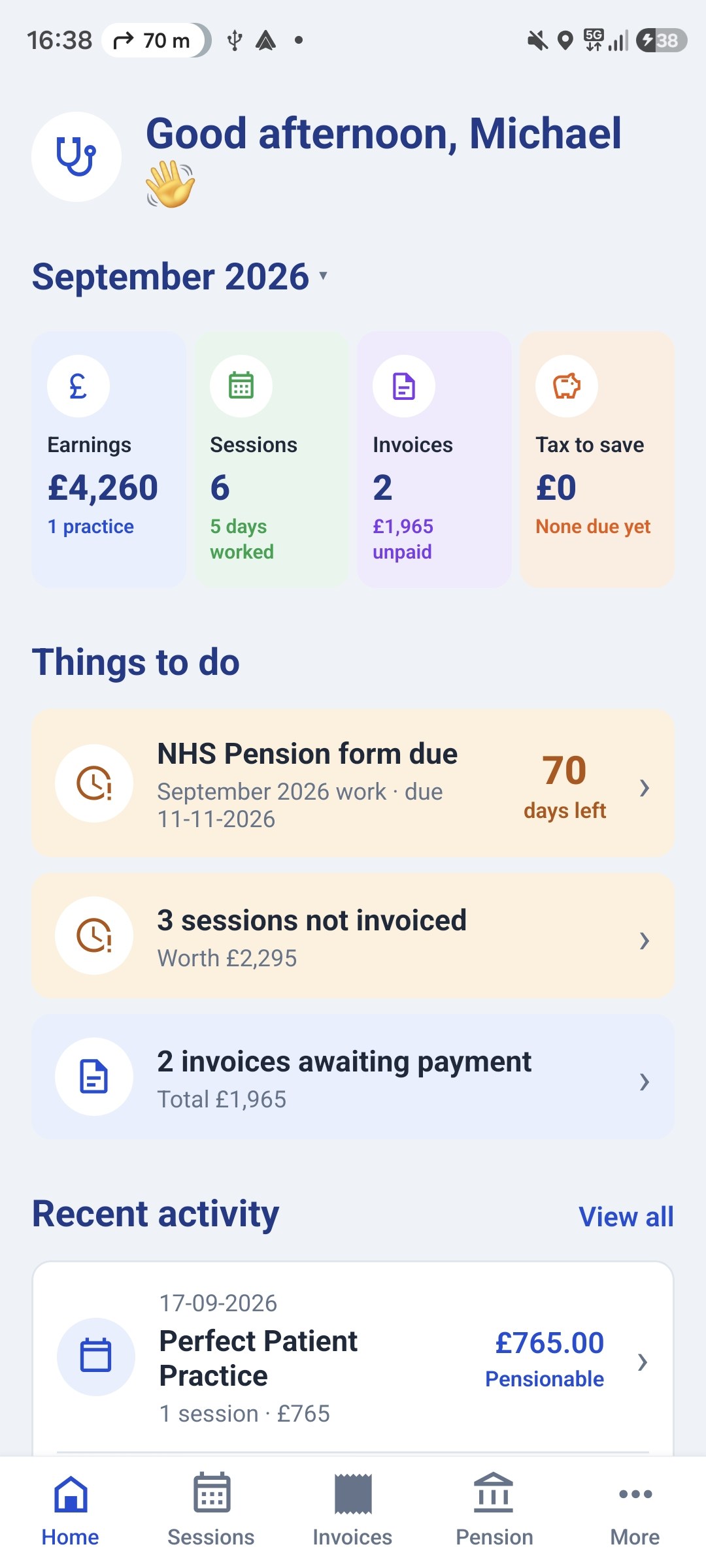
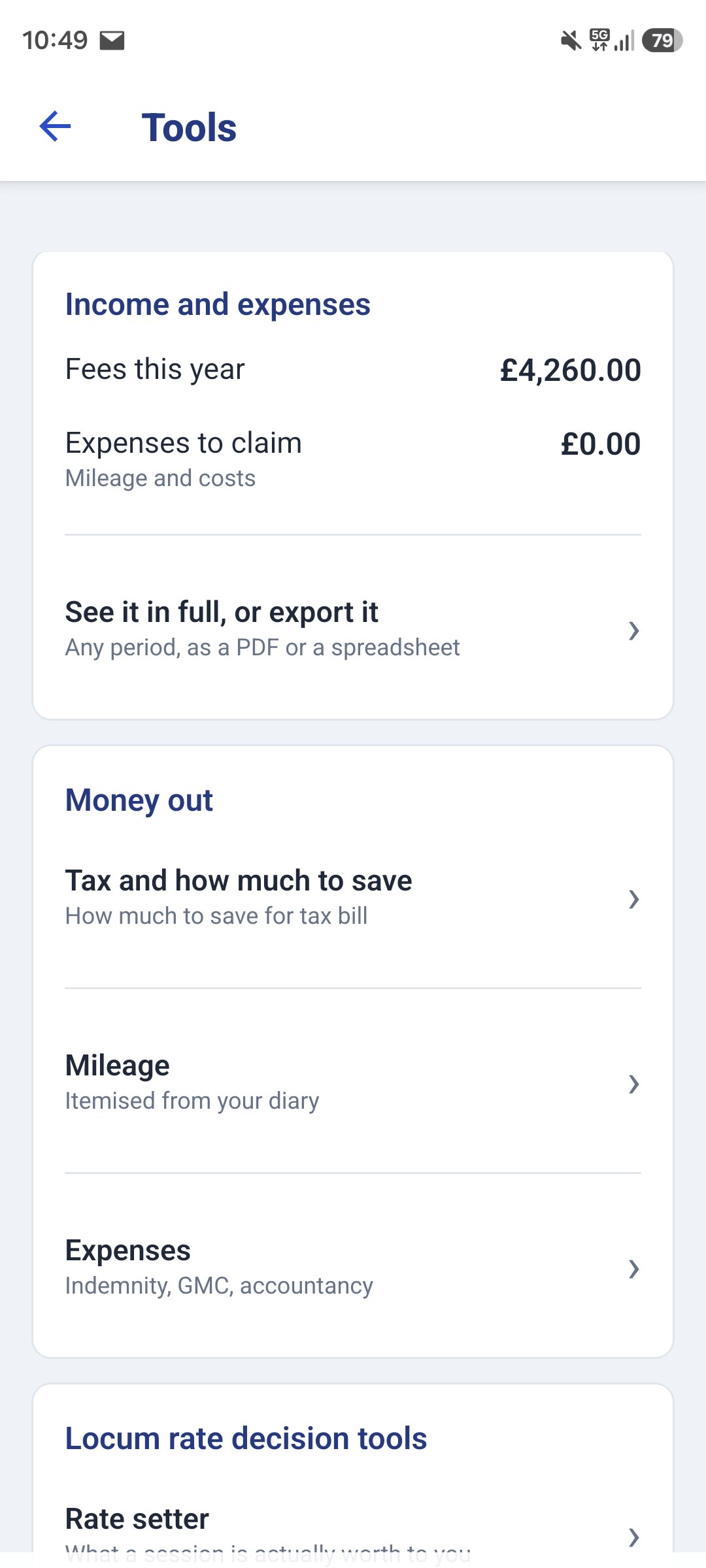
Your indemnity, mileage and sessions in one place
GP Locum records your expenses, MDO subscription included, and the journeys you make between practices alongside the sessions you log, so they are counted in your tax set-aside and your tax return figures. On your phone and on the website.


Locum cover insurance: the practice's side
When a partner or salaried GP is off, the practice has to pay for cover, and that is where locum work often comes from. NHS England reimburses some of the cost, under the Statement of Financial Entitlements. The SFE Directions 2026 set these maximums:
| Absence | What NHS England pays towards cover |
|---|---|
| Parental leave | Up to £1,475.17 a week for the first two weeks, then up to £2,238.03 a week |
| Sickness | Nothing for the first two weeks. Then up to £2,151.96 a week for 26 weeks, and half that for a further 26 weeks |
The payment is the lower of the invoiced cost and the maximum, and it is not reduced for a part-time GP's working pattern. The cover can be an external locum or a GP already at the practice who is not full time.
Locum cover insurance is what practices buy to fill the gaps: the unpaid first two weeks of sickness, the half-rate period, the cost of cover above the weekly maximum, and absences the SFE does not reimburse. A practice chooses a weekly benefit for each GP it insures and a deferred period, commonly from two to 26 weeks, after which the policy pays for up to 52 weeks. Many policies pay the agreed benefit however the absence is covered, and some pay for the sessions a GP cannot do during a phased return.
For a locum, the practical point is that a practice booking cover for an absent GP is often working within these limits.
Frequently asked questions
- Do locum GPs need their own indemnity?
- For clinical negligence claims arising from NHS GP work in England, no: the Clinical Negligence Scheme for General Practice covers locums automatically and free of charge. You still need membership of a medical defence organisation or other cover for everything the state scheme excludes, including GMC investigations, inquests, complaints, private work and Good Samaritan acts. The GMC requires cover for the full scope of your practice.
- Are locum GPs covered by CNSGP?
- Yes, for NHS primary medical services provided under a GMS, PMS or APMS contract in England, for incidents on or after 1 April 2019. There is nothing to register or pay, and it applies however you are engaged, directly by the practice or through an agency or chambers.
- What does CNSGP not cover?
- Private and other non-NHS work, inquests, GMC and other regulatory or disciplinary proceedings, employment and contractual disputes, non-clinical liabilities, Good Samaritan acts, and reports or occupational health work not required under the GP contract. Those need cover from a medical defence organisation or insurer.
- Do locum GPs need income protection insurance?
- It is not required, but a self-employed locum has no sick pay and cannot claim Statutory Sick Pay, and NHS ill health retirement only applies if you are permanently unable to work. Income protection pays a monthly income after a waiting period if illness or injury stops you working, so many locums consider it.
- Do I need business car insurance as a locum GP?
- If you drive between practices or to home visits, you usually need business use cover rather than just social, domestic, pleasure and commuting. Check the wording with your insurer, because a claim made while driving for work on the wrong class of cover can be refused.
- What is locum insurance for GP partners?
- It is cover a practice buys to pay towards the cost of a locum when a partner or salaried GP is off sick or injured. It pays a chosen weekly amount after a deferred period, typically for up to 52 weeks, and fills the gaps left by NHS England's reimbursement, which pays nothing for the first two weeks of sickness and is capped each week.
- Is MDO membership tax deductible for a locum GP?
- For a self-employed locum, indemnity subscriptions for your professional work are generally an allowable business expense, deducted from your profits on your tax return. Keep the receipt with your other expense records.
Sources
Checked 4 October 2026. Where a primary source disagrees with anything here, the primary source wins.
- Insurance, indemnity and medico-legal support for doctors, GMC: the legal requirement, CNSGP for locums in England, what it excludes, run-off cover, Wales and the All Wales Locum Register, Scotland and Northern Ireland
- Clinical Negligence Scheme for General Practice, NHS Resolution, and its CNSGP scope table: out of hours, primary care networks, NHS 111, Good Samaritan acts, reports and occupational health
- General Medical Services Statement of Financial Entitlements Directions 2026, GOV.UK: the parental and sickness leave reimbursement maximums and conditions
- Locum GP cover for parental and sickness leave, BMA
A note on advice
This guide is general information, not insurance or financial advice, and it does not recommend any provider. Indemnity and insurance needs depend on the work you do; check yours with your MDO, and use an independent adviser for income protection.
Try the calculators
Getting Started as a Locum GP
The complete checklist from CCT to your first session: performers list, indemnity, the paperwork practices ask for, HMRC, invoicing, pension forms and what to charge.
Read guide →GP Locum Tax Guide
Every deduction that comes out of a newly qualified locum's fees: tax, Class 4 NI, student loan, pension, expenses and the first 31 January.
Read guide →Portfolio GP Roles
Trainer, appraiser, teaching, examining, tribunal, medical examiner, CQC and expert witness work, with what each pays where it is published.
Read guide →Locum Tax Calculator
Work out what to set aside from your locum fees for tax and National Insurance.
Open tool →New Locum Starter Plan
Starting as a locum GP? What to set aside from every fee, and every tax date and amount to your second 31 January, the first January's double hit included.
Open tool →Know when these figures change
The rates here go out of date every April. Leave your email and I'll keep you updated on changes to these figures for the new tax year and any related GP finance news, pensions, tax and locum money. Unsubscribe any time.