

PCSE Pension Record Wrong or Missing Years: How to Fix It
Your NHS pension record on PCSE Online shows figures that can't be right, or whole years are missing. Who is responsible for correcting it, what to send to whom, and how to escalate when nothing happens.
The short answer
Start where the wrong figure came from, then work up.
- Salaried GP with wrong pay or contributions? Go to the practice manager or payroll first. The figures PCSE shows for a salaried post are the ones the practice entered.
- Missing years? Check on PCSE Online whether a Type 1 or Type 2 form is outstanding for that year, and submit it.
- Raise a GP Pensions enquiry with PCSE through its online form, with evidence, and keep the case reference.
- Complain to [email protected] if the enquiry goes nowhere. PCSE aims to resolve complaints within 40 calendar days.
- Escalate to NHS England if it is not resolved in that time. BMA members can bring in the BMA pensions department at this point.
- The Pensions Ombudsman is the last step, once PCSE and NHS England have both had their chance.
NHS Pensions (NHSBSA) is not the place to start for GP work. It holds the record, but it only knows what PCSE sends it.
How common this is
Very. A freedom of information request from the BMA to NHSBSA found that 18,575 GPs in England had missing pension records, 56% of those who should have had a record complete to 2022/23, with 156,896 years of pension data missing between them.
The BMA is clear on two things. This is primarily a data problem, and the pension you have built up will be honoured. And it still matters that the record is right, because your statements, your annual allowance figures, your McCloud remedy statement and your retirement quote are all produced from it.
So a wrong record is not a reason to panic, and it is not something to leave.
Who holds what
Three organisations are involved, and most wasted time comes from writing to the wrong one.
| What it does | What it can fix | |
|---|---|---|
| Your practice | For a salaried GP, tells PCSE your estimated pensionable pay and tier, and when you join or leave. Contributions are then collected through the practice. | A wrong estimate, a missing Joiner or Leaver form, a salary change that was never notified. |
| PCSE (run by Capita for NHS England) | Administers pension contributions and records for GP work in primary care: salaried, partner, locum and GP SOLO work. Passes them to NHS Pensions. | Unprocessed forms, unallocated payments, wrong adjustments, records it has not passed on. |
| NHS Pensions (NHSBSA) | Runs the scheme and holds your final record. Produces your statements. | Officer service only: hospital posts, GP training, employed ICB or trust roles. It cannot correct GP figures itself. |
Practitioner and officer service are separate. As a GP you are in the practitioner part of the scheme, which PCSE administers. Your years as a resident doctor or GP registrar, and any employed trust or ICB role, are officer service: your employer sent those figures straight to NHS Pensions and PCSE has nothing to do with them. If the gap in your record is from before you qualified as a GP, take it up with NHS Pensions and the employer, not PCSE.
Work out which problem you have
Whole years are missing. Your statement stops several years back, or a year shows no GP pay at all. The usual reason is an end-of-year form that was never submitted or never processed. Records are updated in date order, so one unprocessed year holds up every year after it.
The figures for a salaried post are wrong. Pensionable pay that is several times your salary, the wrong tier, contributions that don't match your payslips, or a post that still shows after you left. These start with what the practice told PCSE.
Locum contributions are missing. You sent Form A and Form B and paid, but the work is not on your Employee Contribution Statement.
There is a negative figure or an adjustment you don't recognise. PCSE applies refunds and recoveries as adjustments. A large negative figure against a year is most likely one of those, or a correction to an earlier entry, rather than pension being taken away. Ask PCSE what it relates to.
The missing service is from before you were a GP. That is officer service. See the note above.
Check what the record actually says
Before contacting anyone, collect what each system shows. You will be asked for it, and it tells you where the fault is.
On PCSE Online:
- Your Employee Contribution Statement, which you can download as a PDF or CSV. PCSE says this shows the contributions your practice has deducted, based on the pensionable pay and tier the practice submitted in its annual estimate. PCSE Online holds the six previous years plus the current one.
- The Type 1 or Type 2 listing screen, which shows each year's certificate as approved, "declarated" (submitted, waiting to be processed) or rejected, with the reason.
From NHS Pensions:
- Your Annual Benefit Statement on the My NHS Pension portal. PCSE notes it is refreshed once a year, in August, using updates made by early June, and only when every earlier year's certificate has been submitted and processed.
- The fuller record, by request. The BMA suggests asking NHS Pensions for your "05 AA service and pay extract" in spreadsheet format and your practitioner's dynamising sheet, plus the NSAY1 value and the added years dynamising sheet if you are buying added years. Send the request to [email protected] with your full name, scheme membership number, date of birth and address, and ask for it to be treated as a subject access request, which has to be answered within one month. BMA members can use the BMA's template emails, linked in the sources.
From your own files: payslips and P60s for salaried posts, the month 12 payslip in particular, Form A and Form B with proof of payment for locum work, and any Type 2 forms you have submitted.
Line the three up year by year. Where your own figures and PCSE's disagree, PCSE is the problem. Where PCSE is right and NHS Pensions is behind, it is usually an earlier year blocking the queue.
Salaried GPs: start with the practice
For a salaried post, PCSE does not work from your payslips. It works from what the practice enters on PCSE Online:
- a Joiner form when you start, confirming your estimated income and tier rate, which is what starts contributions being collected
- an annual estimate of pensionable pay for every GP at the practice, due by the end of February for the year ahead
- a Salary Change form if your estimated income changes during the year
- a Leaver form when you go, which is what stops contributions for that post
So if PCSE shows pensionable pay several times your real salary since you changed jobs, the first thing to check is what the new practice entered on its Joiner form or estimate. A mistyped figure there carries through to every month that follows. The practice has its own reason to care: contributions are collected from the practice on the strength of that figure.
What to ask the practice manager or payroll:
- What estimated pensionable pay and tier did you enter for me on PCSE Online, and from what date?
- If it is wrong, please submit a Salary Change form with the correct figure.
- Has my previous practice submitted a Leaver form? If your old post still shows as open, ask the old practice.
- Do the contributions on the practice's PCSE statement match what has come off my pay?
Your Type 2 form is the backstop. When PCSE processes it, it checks whether the practice paid the right contributions for the year and puts any difference on the practice's next statement. PCSE's guidance is to enter the employee contribution figure from your month 12 payslip, and to share the completed form with the practice if it shows a difference. The Type 2 forms guide covers the form itself.
The practice correcting its figure going forward does not always fix the months already recorded. If the statement is still wrong after the practice has acted, that is when to raise it with PCSE.
Missing years: submit the outstanding form
PCSE's own answer for a missing year is short: submit the certificate for that year. You can do this for any year, at any time, through PCSE Online. For years PCSE Online does not offer, download that year's form from NHS Pensions and send it through PCSE's enquiry form.
Things to know:
- Do the earliest missing year first. Records are updated in date order, so later years will not appear on your NHS Pensions record until the earlier ones have been received and reconciled.
- A salaried GP needs a Type 2 form for every year worked as one. If you never knew you had to file, file them now. PCSE says pensionable pay may be set to zero for a period where the self-assessment is not completed.
- If you no longer have the paperwork, PCSE asks for the certificate or pay evidence for that year. Payslips, P60s and your accountant's records are the usual sources.
- Your statement will lag. Even once PCSE has processed everything, the Annual Benefit Statement only refreshes once a year.
If every form is in and the years are still missing, that is no longer something you can fix yourself. Raise an enquiry, then a complaint.
Locum work that is missing
For locum work the record depends on three things matching: the Form A, the Form B and the payment. PCSE says that if the forms do not carry your unique reference, the work cannot be credited to your record, and the same reference has to be on the BACS payment.
Check the reference on each first. Then send PCSE the Form A and Form B for the month and proof of the payment through the GP Pensions enquiry form. If you submitted by hand, include the dated email showing the Form A went to the practice inside the 10-week window. The locum pension guide covers the forms and the deadline.
Raise an enquiry with PCSE
PCSE takes pension queries through an online form, not by email. On its Contact us page, choose GP Pensions, then GP Pensions enquiry, then New GP Pensions enquiry. For a contributions problem PCSE asks you to include your practice code and your GMC number.
An automated acknowledgement arrives within about 20 minutes with a case reference, usually starting CAS. Keep it. To add evidence or chase, use the Existing GP Pensions enquiry form with that reference, so everything stays on one case.
Attachments can be up to 3.2MB each. PCSE recommends PDF or Excel.
You can copy this and fill in the brackets:
Subject: Incorrect pension record: [your name], GMC [number], [year or years]
Hello,
My NHS pension record for [year] is incorrect.
What it shows: [for example, pensionable pay of £X for my salaried post at practice code Y from date]
What it should show: [for example, pensionable pay of £Z, as on the attached payslips and P60][One or two sentences on what has already been done, for example: the practice submitted a Salary Change form on date.]
Please correct the record for the whole period, confirm the corrected figures to me in writing, and confirm when they will be passed to NHS Pensions.
Full name: [name]
GMC number: [number]
NHS Pension Scheme membership (SD) number: [number]
Practice code: [code]Attached: [Employee Contribution Statement, payslips, P60, Type 2 form]
Thank you,
[name]
Say exactly which figure is wrong and what it should be. "My pension is wrong" gets a request for more information; a named figure with a payslip attached can be acted on.
If nothing happens: complain
A complaint is a separate process from an enquiry, with its own timescales.
- Email: [email protected]. By post: Primary Care Support England, PO Box 350, Darlington, DL1 9QN.
- You need an enquiry first. PCSE's policy says a complaint can only be logged once a query has been raised with the service and it has had time to resolve it, and that the case reference must be given.
- Timescales. Acknowledged within three working days with its own reference, and PCSE aims to resolve complaints within 40 calendar days. Put the date in your calendar.
- Time limit. Within twelve months of the problem, or of you becoming aware of it. PCSE can consider later complaints where there is a good reason.
- Answer anything PCSE asks for. If it requests information and gets no reply, it asks once more, and closes the complaint if nothing arrives within 28 days.
- If you disagree with the outcome, reply to the complaints team to appeal. It is then reviewed by an independent PCSE subject matter expert.
Include a clear description, the CAS reference of your enquiry, copies of the correspondence and the supporting documents. The BMA says PCSE should not close a complaint before it is resolved, and should not issue a new reference for a case that is still open. BMA members have a template complaint letter, linked in the sources.
Subject: Formal complaint: pension record not corrected, [CAS reference]
Hello,
I am making a formal complaint under PCSE's complaints policy.
On [date] I raised a GP Pensions enquiry, reference [CAS number], because my pension record for [year] is incorrect: [one sentence]. I supplied [evidence]. The record has not been corrected.
Please correct the record, confirm the corrected figures to me in writing, and confirm that they have been passed to NHS Pensions.
Full name: [name]
GMC number: [number]
NHS Pension Scheme membership (SD) number: [number]I look forward to your acknowledgement within three working days and a resolution within 40 calendar days.
[name]
Escalating beyond PCSE
NHS England. PCSE works for NHS England. If the complaint is not fully resolved within 40 calendar days, the BMA's guidance is to escalate by email to [email protected]. Give the PCSE case reference, the date of the original complaint, your full name and your scheme membership (SD) number, with the background and correspondence attached.
The BMA, if you are a member. Raise the complaint with PCSE yourself first. If there is no response after the 40 days, or you need help, the BMA pensions department is at [email protected]. Include your membership number. The BMA's pensions committee meets Capita, NHS England and NHS Pensions every two months, so individual cases do get raised.
Compensation. Once the complaint is resolved you can claim for what the error cost you. NHS England's factsheet, which the BMA obtained through a freedom of information request, covers two kinds:
- Non-financial injustice: distress and inconvenience, assessed on the Pensions Ombudsman's fixed bands and not on an hourly rate for your time.
- Financial loss: accountancy fees, tax costs, administration costs, lost interest or interest paid. It has to be evidenced, both the amount and that PCSE's maladministration caused it.
Claims go to [email protected]. Keep your accountant's invoices and a note of dates from the start.
The Pensions Ombudsman. Free and independent. It will expect you to have completed the PCSE and NHS England processes first, and applications generally have to be made within three years of the event, or of when you knew or should have known about it.
The Pensions Regulator. It does not resolve individual cases, but it regulates how schemes are run. The BMA suggests reporting PCSE if you think your record is not being managed properly, through the regulator's online form or on 0345 600 7060.
While it is unresolved
A wrong record causes trouble before it is fixed. Where it matters:
Your tax return. Don't copy a figure from PCSE that you know to be wrong. For a salaried post, your payslips and P60 show what was actually deducted from your pay. Tell your accountant the PCSE statement is in dispute and give them the payslip figures alongside it.
Your Type 2 form. File it on time anyway, using your own records, so the year is not left open. PCSE's guidance is to take the employee contribution from your month 12 payslip. The form is also the mechanism that exposes a difference between what the practice paid and what it should have paid.
Annual allowance. Your pension savings statement is built from the same record. Inflated pensionable pay can produce an inflated pension input amount, and a missing year can mean no statement at all. See the annual allowance guide before acting on a statement you think is wrong.
McCloud. NHS Pensions cannot produce an accurate remedy statement from an incomplete record. If you are close to a decision, say so in your enquiry. The McCloud remedy guide has the timetable.
Retirement. If you plan to claim within the next year or two, start now and say so in every message. An up-to-date record is what allows benefits to be paid on time.
Keep a log. Dates, case references, who said what, and what it has cost you. It is what a complaint, a compensation claim and the Ombudsman all ask for.
Free to start — on iPhone, Android and the web
Keep your own record of your locum pension
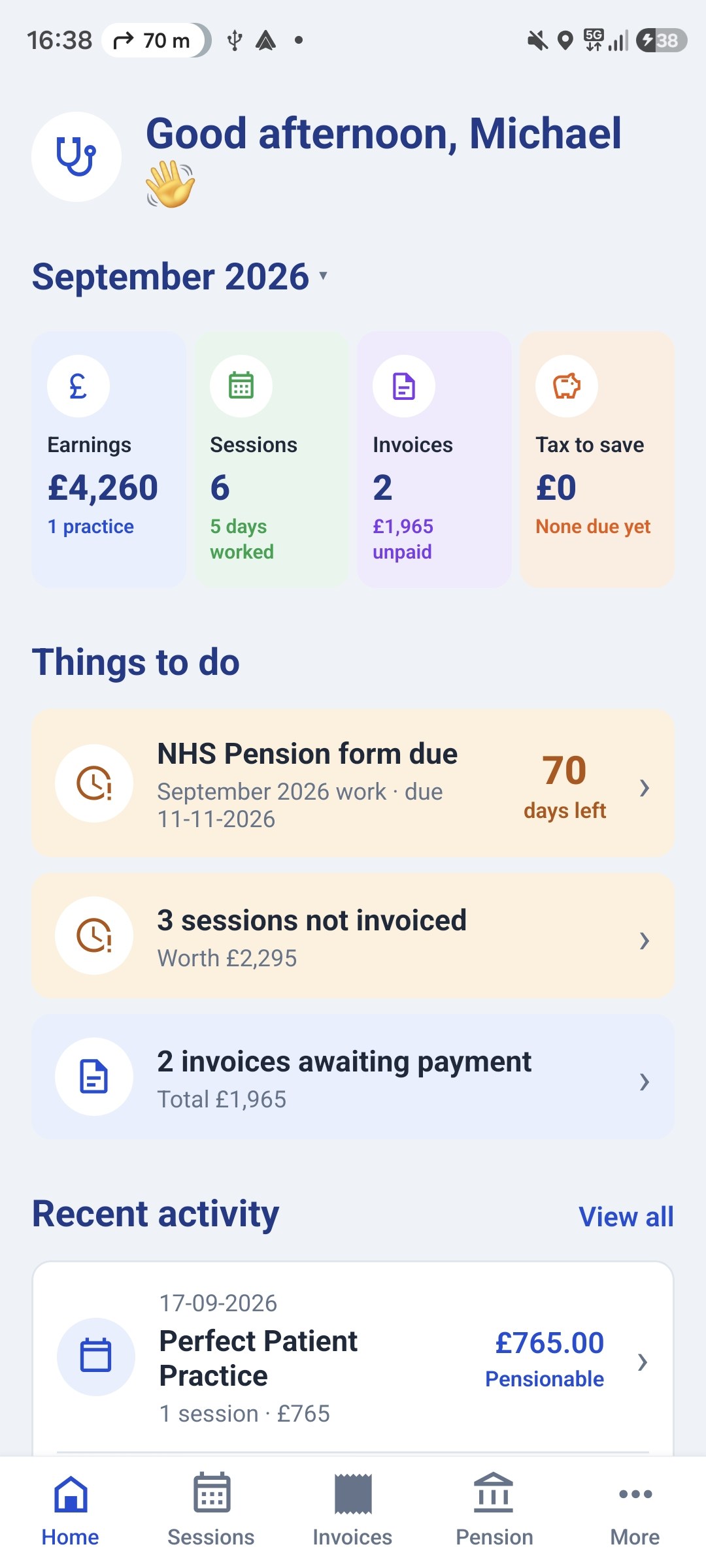
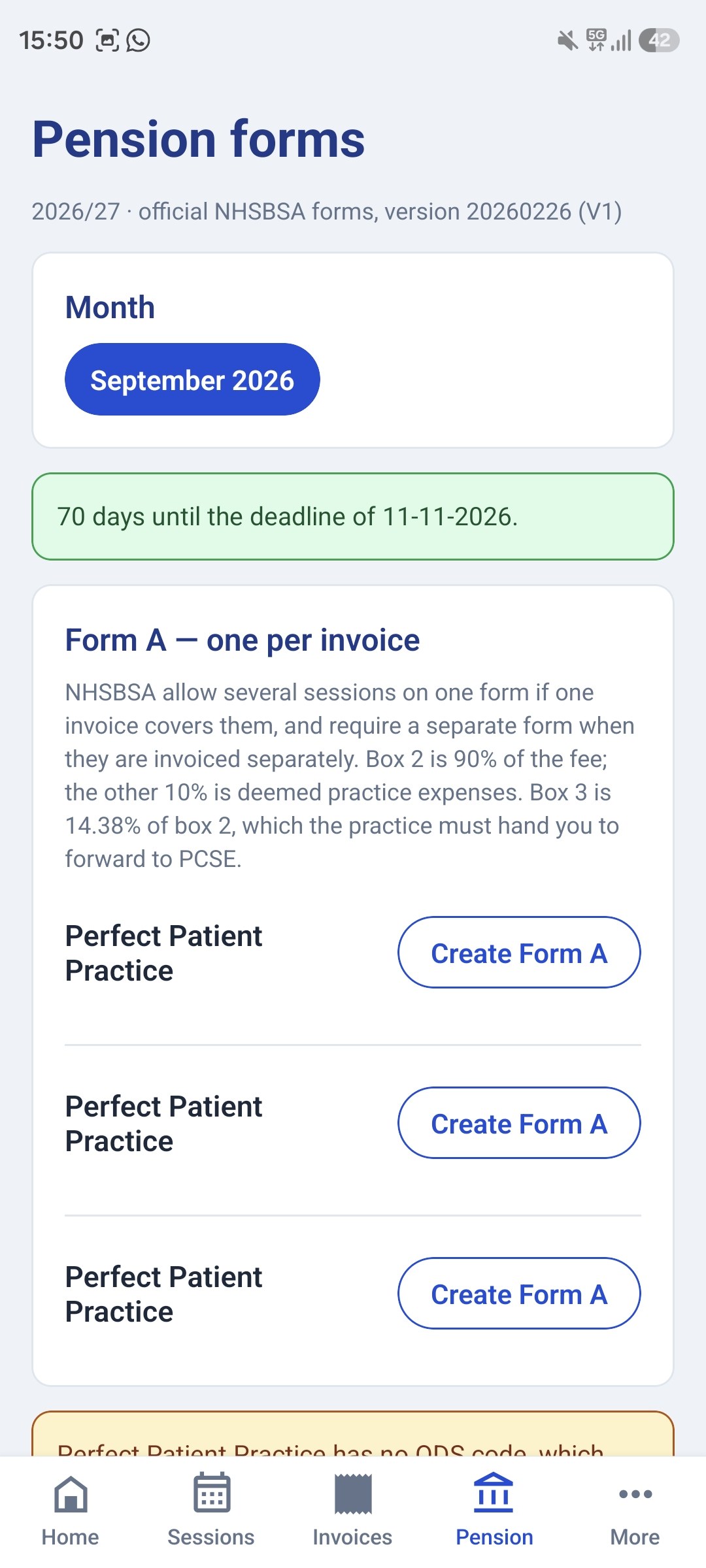
GP Locum records your locum sessions, fills in Form A and Form B for them, and keeps each year's pay and pension contributions in one place, so there is something of your own to check PCSE's figures against. On your phone and on the website.


Frequently asked questions
- Who is responsible for correcting a GP's pension record?
- For GP (practitioner) work in England, PCSE keeps the record of pensionable pay and contributions and passes it to NHS Pensions. For a salaried post the figures PCSE holds come from the practice, so a wrong figure is corrected by the practice submitting the right one on PCSE Online. NHS Pensions cannot correct practitioner figures itself.
- My PCSE statement shows pensionable pay far higher than my salary. What should I do?
- Ask the practice manager or payroll to check the estimated pensionable pay and tier they entered for you on PCSE Online, on the Joiner form or the annual estimate, and to submit a Salary Change form with the correct figure. Then raise a GP Pensions enquiry with PCSE so the months already recorded are corrected.
- Will I lose pension because of a missing year?
- The BMA describes missing years as primarily a data issue and says accrued pension entitlement will be honoured. The record still needs fixing, because statements, annual allowance figures, McCloud statements and retirement quotes are all produced from it.
- How long does PCSE take to resolve a complaint?
- PCSE's complaints policy says complaints are acknowledged within three working days and that it aims to resolve them within 40 calendar days. If it is not resolved by then, the BMA's guidance is to escalate to NHS England.
- Can I complain to PCSE straight away?
- No. PCSE's policy says a complaint can only be logged once a query has been raised with the pensions team and it has had time to resolve it, and that the case reference must be quoted. Raise a GP Pensions enquiry first and keep the reference, which usually starts CAS.
- Can I get compensation for PCSE's mistakes?
- Possibly. NHS England's factsheet covers compensation for distress and inconvenience, and for financial loss such as accountancy fees, tax costs or lost interest, where the loss is evidenced and was caused by PCSE's maladministration. Claims go to [email protected].
- Does this apply in Wales, Scotland or Northern Ireland?
- No. PCSE covers England. In Wales GP pension forms go to the Local Health Board, and Scotland and Northern Ireland have their own schemes and administrators.
Sources
Checked 2 October 2026. Where a primary source disagrees with anything here, the primary source wins.
- Guidance for GPs in England on getting your pension record up to date, BMA, updated 19 January 2026: the step-by-step route, the template emails and letters for members, the escalation and compensation contacts, and the missing-records figures
- The NHS pension scheme as a sessional GP, BMA, updated 17 June 2026: the practice's estimate for salaried GPs
- PCSE complaints policy, PCSE: how to complain, the three working day and 40 calendar day targets, the twelve-month limit and the appeal
- GP Pensions enquiries, PCSE: the new and existing enquiry forms
- General GP Pensions FAQ and Pension adjustments, PCSE: missing or incorrect contributions, the Employee Contribution Statement and how adjustments are handled
- Manage joiners and leavers and Estimate of pensionable profits, PCSE: the Joiner, Leaver and Salary Change forms and the practice's annual estimate
- End of year: Type 2 salaried GP, End of year general FAQ and Missing pension years, PCSE: submitting past years, date-order processing and the statement refresh
- My NHS Pension portal and Locum A and B contributions, PCSE
- Pensions compensation claims factsheet, NHS England, as published by the BMA
- How to complain about a pension problem, the Pensions Ombudsman: completing the formal complaint first, and the three-year limit
A note on advice
This guide is general information for GPs in England, not legal or financial advice. Processes and contact details at PCSE and NHS England change: if anything here does not match what they tell you, they are right. For a tax or annual allowance decision that depends on a disputed record, speak to a specialist medical accountant.
Try the calculators
Type 2 Forms Explained
The self-assessment form for salaried and sessional GPs: who files, annualisation, and the deadlines.
Read guide →Locum GP Pension Guide
Forms A and B, the 90% rule, the 10-week deadline, and the annualisation traps that cost locums pension.
Read guide →Annual Allowance
Pension input amounts, the tapered allowance, carry forward and Scheme Pays, with 2026/27 figures.
Read guide →McCloud Remedy
The choice you'll face on your 2015–2022 service, the timelines, and the tax side that needs action.
Read guide →NHS Pension Calculator
Model your 1995/2008, 2015 CARE, and private pension income across different retirement ages.
Open tool →Know when these figures change
The rates here go out of date every April. Leave your email and I'll keep you updated on changes to these figures for the new tax year and any related GP finance news, pensions, tax and locum money. Unsubscribe any time.